
Take a Break from the Problem
Spring is almost here and along with it, students may be blooming too, with issues that seem overwhelming. A child might be referred to you with anger issues. Maybe an adolescent is walking into your office claiming anxiety is making them unsure about passing the geometry test. Perhaps a teacher is stepping into your office, closing the door and claiming frustration is making her rethink her profession.
Problems can be… problematic!
And, so, if you have been listening to me for a while, you know that I am usually prone to listening well and then asking, “What are your best hopes?” Yet, when problems like this are happening, it seems difficult to get school clients to answer that question.
I have had that happen too.
As a result, in 2017 I wrote a book titled Solution Focused Narrative Therapy because I, too, faced school clients who just could not see out of the problem that was intruding on their lives. I added a narrative therapy component, created by Michael White, called “externalizing the problem.”
When a school client was so stuck that he could not answer the best hopes question, I decided to jump right in there with them and see how we could begin to find some direction. To do that, I had to help the school client “build a case” against the problem by finding out what the problem was doing to them. I found that doing so, motivated them to move away from it quickly, freeing them up to build a preferred future.
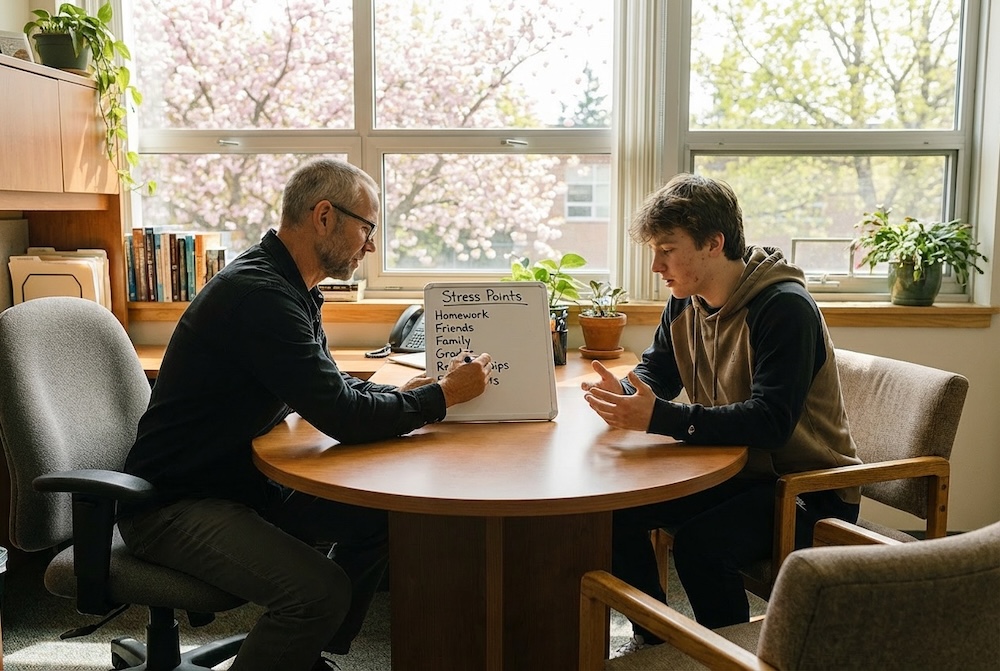
Here are some guiding questions that you might try this week to help school clients who are just plain stuck in a problem. Make a list as you ask the questions with the school client. Then, make a copy, which can be like a map, to take them away from the problem!
“Tell me about the _____ that seems to be taking over. How big is it today, on a scale of 1-10, with 10 the biggest?”
Would it be okay to give the problem a name? If so, what shall we call it?
When ________is around, what happens to you? What else does it do? X10
Tell me times latelyor in the pastwhen it was lower on the scale, just a little. What was going on that helped you to be more in control? What else? Where were you? Who else was there? What else was different in any way?
Suppose, just for this (morning or afternoon), you were to step out of the problem as you leave my office and move one point down on the scale. What might others see you doing that would tell them you were more in charge, not the problem? What else? X10
Questions 1, 2 and 3 are narrative therapy questions. Questions 4 and 5 are quite solution focused. That is the blend of solution focused narrative therapy.
It’s just another tool, adapted from jumping into the world view of the client, a solution focused construct, and finding a way to cooperate with them, wherever they are.
You might even think of taking a break yourself!


