
Spring '25 Professional Development Short Courses | LEARN MORE
Next Free SF Connection
🎉 Don’t Miss Our Year-End SF Connection Celebration — Prizes, Riddles & Special Guests!
Register for SF Connection, Wednesday May 21
10am Pacific, 12pm Central, 1pm Eastern
Become the Counselor You've Always Wanted to Be
Join the Solution Focused School Counseling Certification Program
Stop the Revolving Door of Repeat Student Visits
Become an SF Genius by Mastering Solution Focused School Counseling
Stop Burnout. Start Breakthroughs.
Join us October 10–11 and learn how to do more impactful work in less time - without burning out.
Liberate Yourself by Using the SOLUTION FOCUSED APPROACH FOR SCHOOL COUNSELING
STOP EVERYONE FROM BEING DEPENDENT ON YOU TO FIX EVERYTHING
Create your preferred future, with more time available, fewer repeat referrals, increased academic success and greater staff morale
Turn Everyone's Requests Back to Them and Be Praised as a 'Miracle Worker'
HELP SCHOOL CLIENTS BUILD THEIR OWN SOLUTIONS
Solution Focused Schools Unlimited is the original and most comprehensive resource for educators to learn the solution focused approach and its usefulness in schools, K-12. Created by Linda Metcalf, M.Ed., Ph.D., best-selling author of Counseling Towards Solutions.
Join the rapidly growing solution focused school community, so you can discover this simple and effective approach... and win back your valuable time!

REGISTRATION NOW OPEN FOR DR LINDA METCALF'S LATEST TRAINING COURSE
Introduction to Solution Focused School Counseling
Solution Focused Resources for You to Discover...
The School Counselor's Survival Kit A comprehensive package of solution focused resources
SF Connection A free bi-weekly webinar helping you apply the solution focused approach
Monday Ideas A weekly newsletter with practical solutions for school counselors
Free Solution Focused Resources Documents to download and use in schools at all levels
The Solution Focused School Conference An annual gathering of global solution focused experts
Solution Focused Schools Unlimited Podcast Listen on your favourite platform wherever you are
Solution Focused Books A wide variety of solution focused books authored by Dr Linda Metcalf
On-Demand Video Learning Earn CEUs while you learn the solution focused approach
Workshops & Professional Development Book Dr Linda Metcalf for in-person professional development training
HOW THE SOLUTION FOCUSED APPROACH WORKS
In problem-focused approaches, too much time is spent on identifying what is not working, instead of looking in a variety of contexts for times when things are working.
Using the solution-focused approach, empowerment takes place in the very first meeting and keeps everyone focused on the direction of choice.
For example, a twelve year old with repetitive behavior problems would be asked: "can you tell me about times when you don't let the behavior take you over...what is different then? What do you do, where are you, what are you thinking about, what are your parents or teachers doing?"
ABOUT LINDA

Linda Metcalf PhD is a former middle school teacher, all-level school counselor, licensed professional counselor supervisor, and licensed marriage and family therapist supervisor in the State of Texas. She is a Professor at Texas Wesleyan University and Chair of the Graduate Counseling Programs.
BOOKS OF THE MONTH
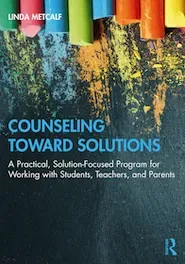
REVISED AND UPDATED. This book provides a solution-focused approach to working alongside students, parents, and teachers that decreases misbehaviors, encourages mental health and growth mindset in students, and provides social emotional learning opportunities.
Complete with specific dialogues for students of all ages, and case studies, this text provides school counselors with a road map to looking beyond problems and seeking solutions with students, creating grit and resilience.
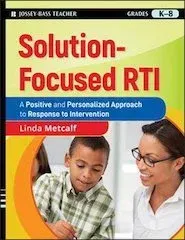
Solution-Focused RTI provides an effective approach to Response-to-Intervention using a "solution-focused" method, which emphasizes a student's strengths rather than his or her weaknesses. This important book guides educators to identify exceptions to students' learning problems and design personalized interventions that can help those students succeed.
LINDA'S BOOKS
The Field Guide to Counseling Toward Solution
Solution-Focused RTI
Teaching Toward Solutions
How to Say It to Get Into the College of Your
Choice
Solution Focused Group Therapy
The Miracle Question
Solution Focused Narrative Therapy
Parenting Toward Solutions
Marriage and F1amily Therapy- A Practice Oriented Approach
The Solution Focused School Climate
Practical tools and strategies for school counselors to help students achieve their goals
Practical tools and strategies for school counselors to help students achieve their goals
© 2026 Solution Focused Schools Unlimited LLC